
For decades, Jantar Mantar has been more than just a historical monument in the heart of New Delhi. While it was originally built to study the movement of celestial bodies, it has gradually evolved into one of India’s most recognised public spaces for peaceful demonstrations. From anti-corruption campaigns and farmers’ movements to student protests and civil society gatherings, Jantar Mantar has witnessed some of the country’s most defining moments of public expression.
Recently, the Cockroach Janta Party (CJP) chose Jantar Mantar for its first protest in India, once again drawing attention to the significance of this iconic venue. The choice of location has sparked curiosity about why organisations—whether political, social or civil—continue to prefer Jantar Mantar as the stage for public demonstrations.
How Jantar Mantar Became Delhi’s Protest Hub
Jantar Mantar’s transformation into a protest site was largely shaped by its strategic location. Situated on Parliament Street, it lies just a short distance from Parliament House, several government ministries, media organisations, and the offices of national political parties. This proximity allows demonstrators to convey their concerns directly to policymakers while remaining within a designated public space.
Over time, authorities began permitting organised protests at Jantar Mantar to maintain a balance between citizens’ right to peaceful assembly and the need to ensure security around Parliament and other sensitive government buildings. As restrictions increased at locations such as Boat Club near India Gate, Jantar Mantar naturally emerged as the capital’s primary venue for public demonstrations.
Its accessibility by road and Delhi Metro, combined with extensive media presence in central Delhi, further strengthened its status as the country’s most prominent protest destination.
Landmark Movements Held at the Observatory
Over the years, Jantar Mantar has hosted a wide range of protests representing diverse social, political, and economic concerns.
Some of the most notable movements include:
- Anna Hazare’s anti-corruption movement (2011): The campaign demanding the Jan Lokpal Bill attracted nationwide participation and marked a turning point in India’s anti-corruption discourse.
- Nirbhaya protests (2012): Following the brutal Delhi gang rape, thousands gathered near Jantar Mantar and surrounding areas, demanding stronger laws to ensure women’s safety and justice.
- One Rank One Pension (OROP): Ex-servicemen held prolonged demonstrations seeking the implementation of OROP for retired armed forces personnel.
- Farmers’ demonstrations: Farmer organisations from different states assembled here to highlight concerns related to agricultural policies, minimum support prices, and rural livelihoods.
- Student and civil society protests: Numerous groups, including students, workers, women, environmental activists, and social organisations, have used Jantar Mantar as a platform to voice their demands on issues ranging from education to environmental protection and human rights.
These movements have cemented Jantar Mantar’s identity as a symbol of democratic participation, where people from across the country come to make their voices heard.
A Monument Built for Astronomy, Not Politics
Ironically, Jantar Mantar was never intended to become a political landmark.
It was constructed in 1724 by Maharaja Sawai Jai Singh II of Jaipur, who was deeply interested in astronomy and scientific observation. The observatory forms part of a network of five astronomical observatories built by the ruler in Delhi, Jaipur, Ujjain, Mathura, and Varanasi.
The site houses large masonry instruments designed to accurately measure time, track planetary positions, calculate eclipses, and observe the movement of celestial bodies. Before the widespread use of modern telescopes and digital technology, these instruments represented some of the most advanced astronomical achievements of their era.
Today, Jantar Mantar remains a protected historical monument managed by the Archaeological Survey of India (ASI), attracting visitors interested in India’s scientific and architectural heritage.
Why CJP Picked Jantar Mantar
The decision by the Cockroach Janta Party (CJP) to organise its first protest in India at Jantar Mantar reflects the venue’s long-standing role as the country’s most recognised site for peaceful demonstrations.
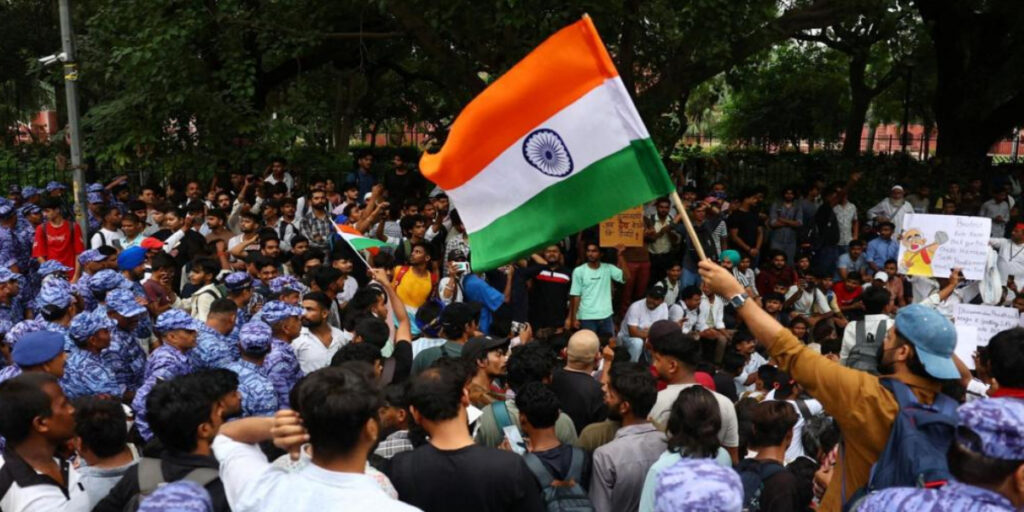
Holding a protest at Jantar Mantar offers several advantages:
- It is India’s best-known venue for organised public demonstrations.
- The site is located close to Parliament and key government institutions, allowing protesters to convey their demands within the national political landscape.
- National media regularly covers events held at the location, giving protests greater visibility.
- It is one of the designated public spaces where authorities permit organised demonstrations, subject to applicable rules and permissions.
- The venue carries symbolic value because many landmark movements that shaped public discourse have been held there over the years.
By choosing Jantar Mantar, CJP placed its inaugural protest at a location that has long been associated with democratic expression, public participation and the right to peaceful assembly.
More Than a Protest Site
Jantar Mantar represents a unique intersection of history, science, and democracy. Built nearly three centuries ago to observe the skies, it has evolved into a place where citizens express their aspirations, concerns, and demands for change.
Whether hosting campaigns for social justice, policy reforms, or public accountability, the observatory continues to embody the democratic principle that peaceful dialogue and public participation are essential to a vibrant republic.
As new movements continue to emerge, Jantar Mantar remains a reminder that while its instruments once measured the movement of planets, its grounds now reflect the pulse of India’s democracy.